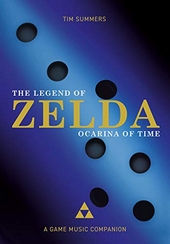
The Legend of Zelda. Ocarina of Time : A Game Music Companion
Summers, Tim
SUMARIO. Chapter 1. Introduction // Chapter 2. The music of Ocarina of Time in context -Nintendo’s game franchises – The Legend of ZeldaKondo’s approach to music in The Legend of Zelda – Music on the Nintendo 64 – Music in Ocarina of Time // Chapter 3. The ocarina and Link’s musical performances – The ocarina – Why an ocarina? – Playing Link’s ocarina – Beyond the four notes – Learning the ocarina songs – The songsPlot-advancing and assistance melodies – Warp songs – The Scarecrow’s song and other performances – The Fabulous Five froggish tenors – The Skull Kids – Musical performance in Ocarina of Time – The function of musical performance in games // Chapter 4. Location cues / Part I. Hyrule Field – A familiar tuneIntroduction – Day tags – Reflective tags – Battle tags – Music, the player and geography / Part II. Location cues featuring ocarina songs – Epona’s song and Lon Lon Ranch – Associations of ranch lifeThe Temple of Time and the Song of Time – Cathedral soundscape – Windmill and the Song of Storms – Strange circularitySaria’s song and the Lost Woods – Jolly repetition and misdirection / Part III. Dungeon cues – Inside the Deku Tree – Organic timbres – Dodongo’s Cavern – Audio textures of metal and stone – Inside Jabu-Jabu’s belly – Fishy rumblings – Forest Temple – Sounds of the forest – Fire Temple – Voices heard and unheard – Ice Cavern – Crystalline chimesWater Temple – A dungeon on the Danube? – Shadow Temple and the bottom of the well – Voices and drums from the depths – Spirit TempleGanon’s Castle/ Part IV. Towns – Kokiri Forest – Optimism and ornamentation – Castle Town market – Evoking European traditions – Kakariko Village – A wistful safe haven – Goron City – Sounding the materials of the mountain – Zora’s domain – Gerudo Valley – Hispanic traditions in the desert // Part V. Recurring types of location – Shops – Hyrule’s consumer soundtrack – Sideshow minigames – The fairground connection – Houses – A musical starting point – Potion shops, ghost shops and lakeside laboratory – Little shops of horrors? – Fairy Fountain/start menu – Angelic harps – Music for locations // Chapter 5. Character themes and cutscenes / Part I. Character themes – Zelda’s theme – Lilting lullaby – Ganondorf’s theme – Alarming chords and brooding sequencesSheik – Atypical warrior’s theme – Kaepora Gaebora (the great wise owl) – Authority and levity – Great Deku Tree – Ancient uncertainty – Koume and Kotake – A noticeable omission / Part II. Other cutscenes – Opening – An unexpected start – Flying – Musical sequences for beating wings – Legends, spirits and goddesses – Rewards and milestones End credits – Finale ultimo – Ocarina of Time 3D – Music for cutscenes // Chapter 6. Ludic cues / Part I. Combat music – Musical features of combat cues – Implementation in the game – Boss victory cue / Part II. Cues for treasure and challenges – Acquisition cuesMusic for puzzles Music for losing – Game over – Minigames – Frivolous fun – Special sequences – Aestheticizing the Ludic // Chapter 7: Interfaces and sound effects – Earcons for interfaces – Menus and dialogue – Targeting system – Musical sound for interfaces and information – Musicality and magic – Sound and motion – Enemy sound effects – Conclusions // Chapter 8. Ocarina afterlives – Later games – Parallel world – Majora’s mask – Selective franchise continuity – Decontextualizing sound – A multi-valent musical medium.
The Legend of Zelda. Ocarina of Time : A Game Music Companion
Summers, Tim
SUMARIO. Chapter 1. Introduction // Chapter 2. The music of Ocarina of Time in context -Nintendo’s game franchises – The Legend of ZeldaKondo’s approach to music in The Legend of Zelda – Music on the Nintendo 64 – Music in Ocarina of Time // Chapter 3. The ocarina and Link’s musical performances – The ocarina – Why an ocarina? – Playing Link’s ocarina – Beyond the four notes – Learning the ocarina songs – The songsPlot-advancing and assistance melodies – Warp songs – The Scarecrow’s song and other performances – The Fabulous Five froggish tenors – The Skull Kids – Musical performance in Ocarina of Time – The function of musical performance in games // Chapter 4. Location cues / Part I. Hyrule Field – A familiar tuneIntroduction – Day tags – Reflective tags – Battle tags – Music, the player and geography / Part II. Location cues featuring ocarina songs – Epona’s song and Lon Lon Ranch – Associations of ranch lifeThe Temple of Time and the Song of Time – Cathedral soundscape – Windmill and the Song of Storms – Strange circularitySaria’s song and the Lost Woods – Jolly repetition and misdirection / Part III. Dungeon cues – Inside the Deku Tree – Organic timbres – Dodongo’s Cavern – Audio textures of metal and stone – Inside Jabu-Jabu’s belly – Fishy rumblings – Forest Temple – Sounds of the forest – Fire Temple – Voices heard and unheard – Ice Cavern – Crystalline chimesWater Temple – A dungeon on the Danube? – Shadow Temple and the bottom of the well – Voices and drums from the depths – Spirit TempleGanon’s Castle/ Part IV. Towns – Kokiri Forest – Optimism and ornamentation – Castle Town market – Evoking European traditions – Kakariko Village – A wistful safe haven – Goron City – Sounding the materials of the mountain – Zora’s domain – Gerudo Valley – Hispanic traditions in the desert // Part V. Recurring types of location – Shops – Hyrule’s consumer soundtrack – Sideshow minigames – The fairground connection – Houses – A musical starting point – Potion shops, ghost shops and lakeside laboratory – Little shops of horrors? – Fairy Fountain/start menu – Angelic harps – Music for locations // Chapter 5. Character themes and cutscenes / Part I. Character themes – Zelda’s theme – Lilting lullaby – Ganondorf’s theme – Alarming chords and brooding sequencesSheik – Atypical warrior’s theme – Kaepora Gaebora (the great wise owl) – Authority and levity – Great Deku Tree – Ancient uncertainty – Koume and Kotake – A noticeable omission / Part II. Other cutscenes – Opening – An unexpected start – Flying – Musical sequences for beating wings – Legends, spirits and goddesses – Rewards and milestones End credits – Finale ultimo – Ocarina of Time 3D – Music for cutscenes // Chapter 6. Ludic cues / Part I. Combat music – Musical features of combat cues – Implementation in the game – Boss victory cue / Part II. Cues for treasure and challenges – Acquisition cuesMusic for puzzles Music for losing – Game over – Minigames – Frivolous fun – Special sequences – Aestheticizing the Ludic // Chapter 7: Interfaces and sound effects – Earcons for interfaces – Menus and dialogue – Targeting system – Musical sound for interfaces and information – Musicality and magic – Sound and motion – Enemy sound effects – Conclusions // Chapter 8. Ocarina afterlives – Later games – Parallel world – Majora’s mask – Selective franchise continuity – Decontextualizing sound – A multi-valent musical medium.